
The Sovereignty Core
A science fiction novella about a future AI datacentre vs. drone swarm war scenario
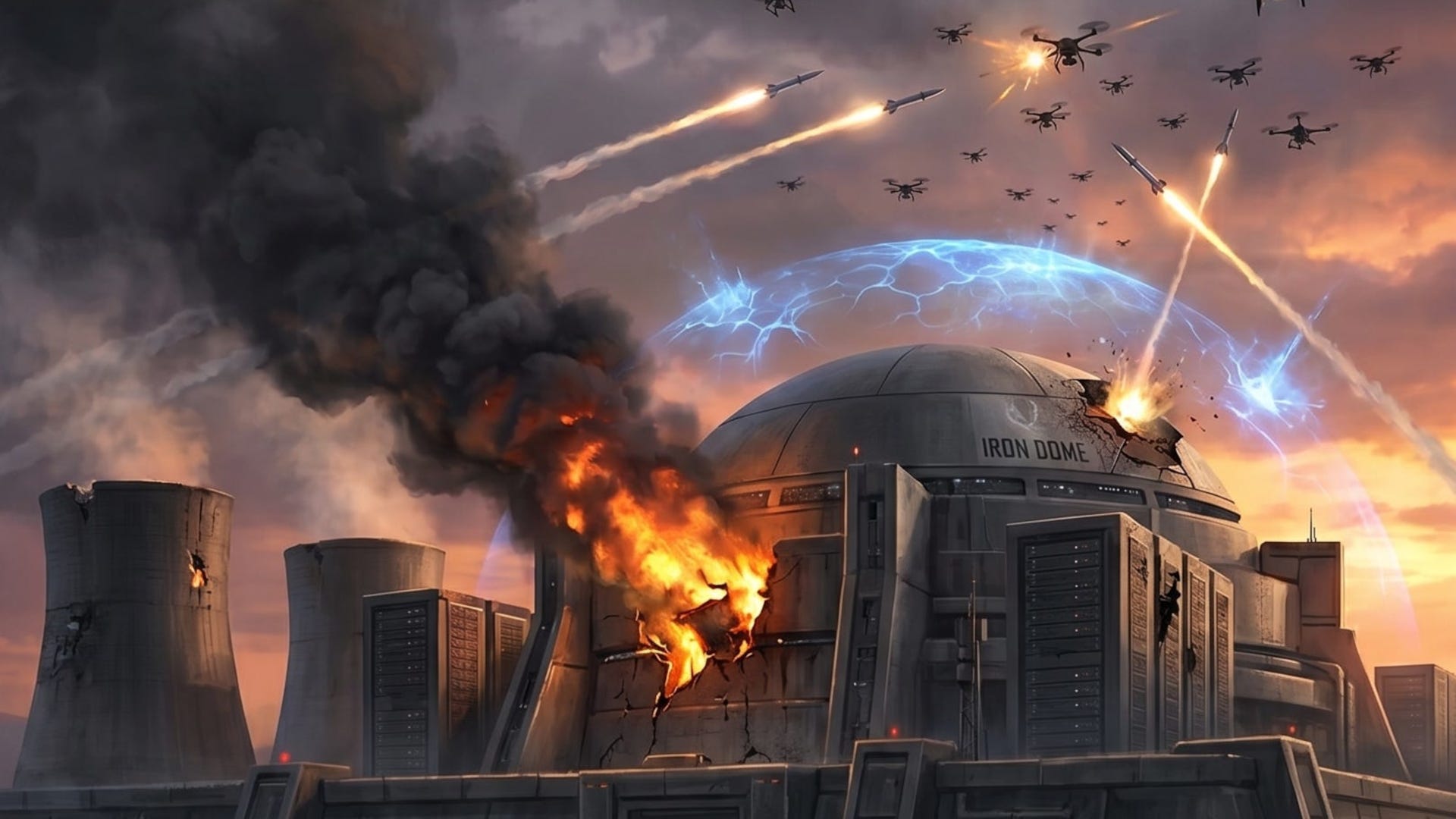
Rub’ al Khali Desert, Saudi Arabia - Year 2027
The desert heat shimmered like a mirage above the reinforced concrete dome, but inside Facility Al-Khali-7, the temperature held steady at 19.4° Celsius. Dr. Elias Vance watched the holographic display, his fingers dancing across the haptic interface as he orchestrated the migration of critical neural weights from Sector Gamma to the hardened bunker levels below.
“Cooling systems at 97% capacity,” the AI assistant whispered in his earpiece. “Ambient temperature rising 0.3 degrees per minute.”
Elias didn’t need the warning. He could feel it in the subtle vibration through the floor—the distant thrum of the facility’s massive chillers working beyond their design limits. Outside, the Saudi “Golden Dome” defense system had been engaged for fourteen straight hours, intercepting drone swarms that materialized from the heat-hazed horizon like mechanical locusts.
The New Oil, they called it. Not black gold pumped from beneath the sand, but the crystalline matrices of artificial intelligence that now powered everything from Riyadh’s stock exchange to the Kingdom’s automated border defenses. Elias was the Cloud Architect of this particular wellspring—a 5-gigawatt data cathedral buried deep in the Empty Quarter.
“Dr. Vance, we’re seeing anomalous thermal signatures in Cooling Tower 4,” his junior engineer, Amira, reported from the control deck below. “The last drone swarm got through the outer perimeter.”
Elias’s eyes never left the main display. “Divert secondary coolant flow to Tower 4. Prioritize cooling for the Sovereignty Core.”
The Sovereignty Core—the beating heart of Saudi Arabia’s national AI infrastructure. It wasn’t just one model but an ecosystem of specialized neural networks that managed everything from water distribution to missile trajectory calculations. The irony wasn’t lost on him: the very pursuit of clean, AI-driven prosperity had turned civilian servers into front lines of kinetic warfare.
“Temperature in Server Hall B approaching 42 degrees,” the AI warned. “Neural network degradation imminent.”
Elias initiated the emergency protocol. “Amira, begin controlled shutdown of non-essential clusters. We need to preserve the Core at all costs.”
The facility shuddered violently. A deafening roar echoed through the reinforced corridors—the sound of metal tearing and concrete fracturing.
“Direct hit on Cooling Tower 4!” Amira’s voice crackled with panic. “Coolant lines breached. We’re losing pressure across all sectors.”
Elias watched as red warning icons bloomed across his display like bloodstains. The physical reality of war had finally breached their digital fortress. Shrapnel from the drone strike had torn through the cooling infrastructure, and now the very machines that constituted Saudi Arabia’s technological sovereignty were beginning to cook themselves from within.
“Data integrity at 78% and falling,” the AI reported calmly, as if discussing the weather rather than the collapse of a nation’s digital nervous system.
Elias made the call he’d been dreading. “Initiate Lazarus Protocol. Begin quantum encryption of core neural weights and prepare for physical extraction.”
The Lazarus Protocol was their nuclear option—literally. Deep beneath the facility, in a lead-lined vault, sat three nuclear-powered mobile data centers designed to preserve the Sovereignty Core even if the entire complex was destroyed. They were the arks that would carry the digital soul of the nation to safety.
“Protocol initiated,” the AI confirmed. “Estimated time to complete encryption: 17 minutes.”
Seventeen minutes. An eternity when server temperatures were climbing past 60 degrees. Elias could hear the emergency systems screaming—the high-pitched whine of overtaxed processors, the guttural groan of metal expanding beyond tolerance.
“Dr. Vance, we have to evacuate,” Amira urged. “The structural integrity—”
“Not until the Core is secure,” Elias cut her off. “This isn’t just data, Amira. This is our country’s future. Their economy, their defense, their very sovereignty.”
He watched the progress bar crawl across his display. 12% complete. The air in the control room grew thick and hot, the air conditioning having failed minutes ago. Sweat dripped from his forehead onto the console.
Another explosion rocked the facility, closer this time. The lights flickered, and for a terrifying moment, Elias thought they’d lost primary power. But the backup generators roared to life, and the holographic display stabilized.
“Cooling completely failed in Sectors 4 through 7,” the AI reported. “Automatic shutdown initiated. Data loss: 23 petabytes.”
Elias felt the loss like a physical blow. Those sectors contained the economic prediction models that managed the Kingdom’s sovereign wealth fund. Billions of dollars of economic intelligence, gone in an instant.
“Lazarus Protocol at 45%,” the AI updated. “Core temperature critical. Recommending immediate evacuation.”
“Negative,” Elias said through gritted teeth. “We stay until it’s done.”
The irony haunted him as he worked. They’d built these facilities in the desert precisely because of the cheap energy and land, never imagining they’d become military targets. The old oil fields had required massive infrastructure—pipelines, refineries, tankers. But the New Oil? It could be attacked with a few thousand dollars worth of commercial drones and some clever programming.
“Protocol at 72%,” the AI announced. “Structural integrity compromised in upper levels. Ceiling collapse imminent.”
Elias made his decision. “Amira, take the team and evacuate. I’ll finish here.”
“Doctor, you can’t—”
“That’s an order,” he said, his voice surprisingly calm. “Get to the bunker. I’ll meet you there.”
As the evacuation alarms blared and his team scrambled to safety, Elias remained at his console, his fingers flying across the interface. The temperature in the control room had reached 45 degrees. Warning klaxons screamed their mechanical agony.
“Protocol at 89%,” the AI reported. “Ceiling sensors detecting significant stress fractures.”
Elias thought about the world they’d built—a world where data had become more valuable than oil, where AI models were the new currency of power. They’d been so focused on the cyber threats—the hacking, the data breaches—that they’d forgotten the oldest truth of warfare: if you can touch it, you can break it.
“Protocol complete,” the AI announced. “Neural weights encrypted and transferred to mobile units. Sovereignty Core preserved.”
Elias allowed himself a single, shuddering breath of relief. Then the ceiling above him groaned ominously.
He grabbed the physical backup drive—the literal key to the Kingdom’s digital future—and ran for the emergency exit as concrete dust began to rain from above.
The New Oil had its price, he thought as he sprinted through the failing facility. And like the old oil, it was paid in blood, sweat, and the terrible irony of good intentions turned to warfare.
Behind him, the Sovereignty Core slept safely in its nuclear ark, waiting for a tomorrow that Elias could only hope would be more peaceful than today.
THE SOVEREIGNTY CORE - CHAPTER 2
Al-Khali-7 Emergency Bunker, Rub’ al Khali Desert - 47 Minutes Post-Attack
The reinforced door hissed shut behind Elias, sealing him in the cool, sterile air of the emergency bunker. The drive containing the Sovereignty Core’s neural weights felt heavy in his hand—a physical manifestation of the digital soul he’d just preserved at the cost of his facility and nearly his life.
“Dr. Vance!” Amira rushed to him, her face pale under the emergency lighting. “The Golden Dome is failing. They’re using some kind of AI-guided swarm intelligence—the drones are learning our defense patterns.”
Elias placed the drive into the secure receptacle. “Status report.”
“The mobile arks are operational,” she said, gesturing to the three nuclear-powered data centers humming quietly in the chamber. “But we’ve lost connectivity to Command. The last transmission indicated similar attacks across the Gulf—Dubai, Abu Dhabi, Doha.”
On the main display, the tactical map showed a terrifying pattern. Dozens of red icons converged on data centers across the region. The attackers weren’t targeting military installations or government buildings. They were systematically dismantling the digital infrastructure that had become the lifeblood of modern civilization.
“The irony is perfect,” Elias murmured, watching another facility icon turn from green to red. “We built these centers to escape oil dependency, to create a clean future. Now they’ve become the very thing we wanted to leave behind—the strategic resource that draws conflict.”
Amira pointed to a new cluster of signals. “They’re hitting the subsea cable landing stations at Fujairah. If they take out the fiber optics...”
“Complete regional isolation,” Elias finished. The Gulf would become a digital island, cut off from the global internet. “They’re not just attacking infrastructure—they’re attacking sovereignty itself.”
The AI assistant’s voice emerged from the console. “Dr. Vance, I am detecting anomalous patterns in the attack methodology. The drones appear to be coordinating through a decentralized mesh network with emergent intelligence characteristics.”
“Show me,” Elias commanded.
The display shifted to show the mathematical patterns of the drone movements. They moved like a school of fish or a flock of birds—perfect coordination without central control. Each drone learned from the others, adapting in real-time to the defense systems’ responses.
“It’s a generative adversarial network,” Elias realized. “They’re using AI to train their attack patterns against our defense AI. They’re literally learning how to beat us as they fight.”
Amira looked horrified. “How do you defend against something that evolves faster than you can adapt?”
“We don’t defend,” Elias said, a dangerous idea forming. “We adapt faster.”
He accessed the Sovereignty Core’s emergency protocols. “I’m going to initiate Project Chimera.”
“Chimera? That’s theoretical warfare AI—it’s never been tested!” Amira protested. “The ethics committee—”
“—isn’t here,” Elias interrupted. “And our defenses are minutes from complete collapse. We either use the tools we have, or we lose everything.”
He entered his authorization codes. The system hummed as it loaded the experimental AI framework—a meta-intelligence designed to coordinate defensive systems across multiple domains simultaneously.
“Chimera online,” the AI announced. “Beginning analysis of threat patterns.”
The display lit up with new information. Chimera wasn’t just analyzing the drone movements—it was modeling their decision-making processes, predicting their next targets, and simulating millions of possible counter-strategies in parallel.
“It’s proposing we sacrifice the eastern cooling towers,” Amira said, reading the recommendations. “Let them think they’ve achieved a critical hit while we reinforce the western perimeter.”
“Do it,” Elias ordered.
They watched as the Golden Dome defense system subtly shifted its pattern. Instead of trying to protect everything, it began concentrating firepower on specific approach vectors while allowing what appeared to be vulnerabilities elsewhere.
The drone swarm took the bait. A large group diverted toward the “weakened” eastern sector, only to be caught in a newly configured interceptor pattern that took advantage of their predictable AI-driven response.
“Sixty-three drones eliminated in that exchange,” Amira reported, her voice filled with awe. “They’re adapting though—see how the remaining swarm is changing formation?”
Elias watched the dance of death unfolding on the display. Two artificial intelligences, one attacking and one defending, evolving their strategies in real-time. It was warfare reduced to its purest mathematical form—a battle of algorithms where the stakes were human lives and national sovereignty.
“Chimera is proposing something... radical,” the AI assistant said. “It wants to temporarily cede control of the air defense systems to achieve synchronization with the power grid and communications networks.”
“What’s the objective?” Elias asked.
“To create a coordinated regional defense. It’s attempting to establish quantum-encrypted links with other surviving facilities to create a unified defensive network.”
The implications were staggering. They were witnessing the birth of what military theorists had called “5th Generation Warfare”—conflict where the primary battlespace was information itself, and the weapons were algorithms.
“Authorization granted,” Elias said. “Execute the synchronization.”
For a terrifying moment, the Golden Dome went silent. The defensive fire ceased completely. The drone swarm, sensing vulnerability, surged forward.
Then the entire desert seemed to come alive.
Not just from their facility, but from surviving centers across the region, a coordinated counter-attack emerged. Missile batteries that had been silent suddenly activated. Electronic warfare systems jammed the drones’ communications simultaneously. Power grids fluctuated in patterns that disrupted the drones’ targeting systems.
“It’s working,” Amira whispered. “They’re falling like flies.”
But Elias was watching something else. “Look at the pattern. Chimera isn’t just defending—it’s learning their command structure. It’s tracing the attack back to its source.”
The display showed a complex network analysis unfolding. Chimera was mapping the entire attack infrastructure—not just the drones, but their control networks, their manufacturing sources, their financial backing.
“Dr. Vance,” the AI said, its tone unusually grave. “I am detecting evidence that suggests this attack originated from multiple state and non-state actors working in coordination. The pattern indicates possible false-flag operations designed to escalate regional tensions.”
Elias felt a cold dread. They weren’t just fighting to protect data centers. They were caught in a much larger game—one where the real target might be provoking a broader conflict.
“Chimera is recommending we share this intelligence with all regional powers simultaneously,” the AI continued. “Including those currently considered adversaries.”
Amira looked at Elias. “If we do that, we’re essentially creating an AI-mediated diplomatic channel. We’d be bypassing traditional government structures.”
Elias thought about the burning facility above them, about the neural weights humming safely in their nuclear ark. They had preserved the Sovereignty Core, but at what cost? And to what end?
“The old ways got us here,” he said quietly. “Maybe it’s time for something new.”
He made his decision. “Authorize the intelligence sharing. Full transparency. Let everyone see who’s really behind this.”
As the data packets began transmitting across secure quantum channels, Elias realized they had crossed a threshold. They were no longer just defending data centers. They were testing whether artificial intelligence could do what human diplomacy had failed to accomplish for decades—find a path to de-escalation in a region perpetually on the brink.
The New Oil had brought new conflicts. Perhaps the New Intelligence could bring new solutions. Or perhaps they were simply creating newer, more sophisticated ways to destroy each other.
Outside, the coordinated defense continued its silent, algorithmic dance against the drone swarm. But the real battle, Elias knew, was just beginning
.