
Global Security Update #1
The age of nuclear brinkmanship
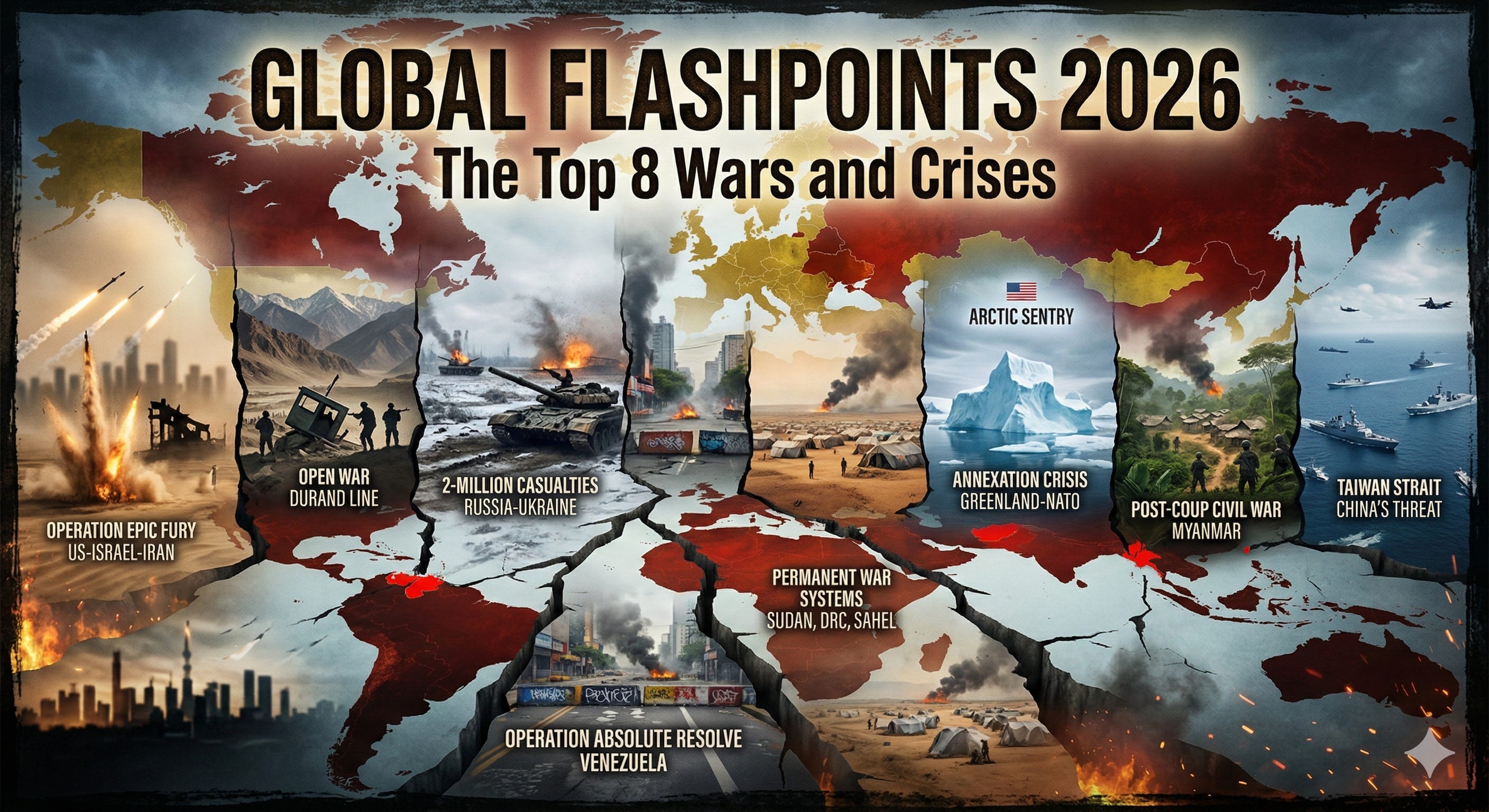
As of March 1, 2026, the global security landscape has shifted toward high-intensity, direct interstate warfare and high-stakes brinkmanship and the breakdown of long-standing alliances between nuclear-armed powers.
Here is the PFN list of the top 8 global wars and crises, ranked by their current threat to international order and human life.
1. The U.S.–Israel War on Iran (Operation Epic Fury)
This is currently the world’s most dangerous active conflict.
The Situation: Following massive joint U.S.–Israeli strikes on February 28, 2026—which reportedly killed Supreme Leader Ali Khamenei—Iran has launched retaliatory ballistic missile barrages across the Gulf.
The Threat: The Strait of Hormuz is a combat zone; global oil prices are spiraling, and the risk of a multi-front war involving Lebanon and Syria is at its highest point in history.
2. The Pakistan–Afghanistan “Open War”
A conventional war between two nuclear-adjacent powers that has shattered regional stability.
The Situation: On February 27, 2026, Pakistan declared “Open War” against the Taliban government. Pakistani air strikes have hit Kabul and Kandahar, killing hundreds of personnel in response to cross-border terrorism.
The Threat: This conflict risks a total state collapse in either nation and could draw in regional neighbors like India or China.
3. Russia–Ukraine: The 2-Million-Casualty War
Now in its fifth year, the war has reached a grim milestone of human loss.
The Situation: Ukraine has regained momentum in the south, while Russia’s war economy continues to fuel massive, grinding offensives in the Donbas.
The Threat: Combined casualties are approaching 2 million. The war remains the primary driver of European rearmament and a constant risk for NATO–Russia escalation.
4. The Venezuela Military Intervention (Operation Absolute Resolve)
The U.S. has transitioned from sanctions to direct military action in the Western Hemisphere.
The Situation: In January 2026, U.S. forces captured Nicolás Maduro and brought him to New York for trial. The country is currently plagued by urban guerrilla warfare between U.S. occupation forces and “colectivo” militias.
The Threat: The intervention has created a massive power vacuum, causing a humanitarian collapse and a refugee crisis that affects the entire continent. See El Mencho.
5. Africa’s “Permanent War” Systems (Sudan, DRC, Sahel)
Africa is facing a convergence of state fragmentations that no longer respect national borders.
The Situation: Sudan has effectively dissolved into military fiefdoms facing a 25-million-person famine; the DRC is embroiled in a “mineral war” over green-tech resources; and the Sahel has become a contiguous jihadist corridor.
The Threat: These are “permanent war systems” where violence is fueled by resource smuggling, making traditional peace treaties almost impossible to enforce.
6. The Greenland–NATO Annexation Crisis
An unprecedented internal crisis within NATO involving a territorial threat from the U.S. against a fellow member.
The Situation: President Trump has threatened 25% tariffs on European allies to force the transfer of Greenland. Denmark has responded by deploying “Arctic Sentry” forces to the territory.
The Threat: This has caused a historic rift in NATO, forcing European allies to militarily defend territory from their own lead ally for the first time in the alliance’s history.
7. Myanmar: The Post-Coup Civil War
The junta’s control has reached its lowest point as resistance forces encircle major cities.
The Situation: Resistance coalitions now control the majority of border regions, prompting the junta to use desperate scorched-earth air strikes on civilian centers.
The Threat: Over 4 million people are internally displaced. The conflict is increasingly spilling over into Thailand and Bangladesh, threatening a wider Southeast Asian security collapse.
8. China’s Threat to Taiwan (The “Perfect Storm”)
The Taiwan Strait has reached a volatile phase, with expert analysis suggesting 2026 is a critical window for “reunification.”
The Situation: China has increased the intensity of its military exercises and “gray zone” incursions. Recent purges within the PLA (Chinese military) have signaled a shift toward readiness for high-intensity operations.
The Threat: Any kinetic conflict in the Taiwan Strait would trigger a global economic depression and likely involve a direct military confrontation between China and the United States.